India Joins Pax Silica: A Strategic Leap into the Global Tech Alliance Reshaping the Silicon Future
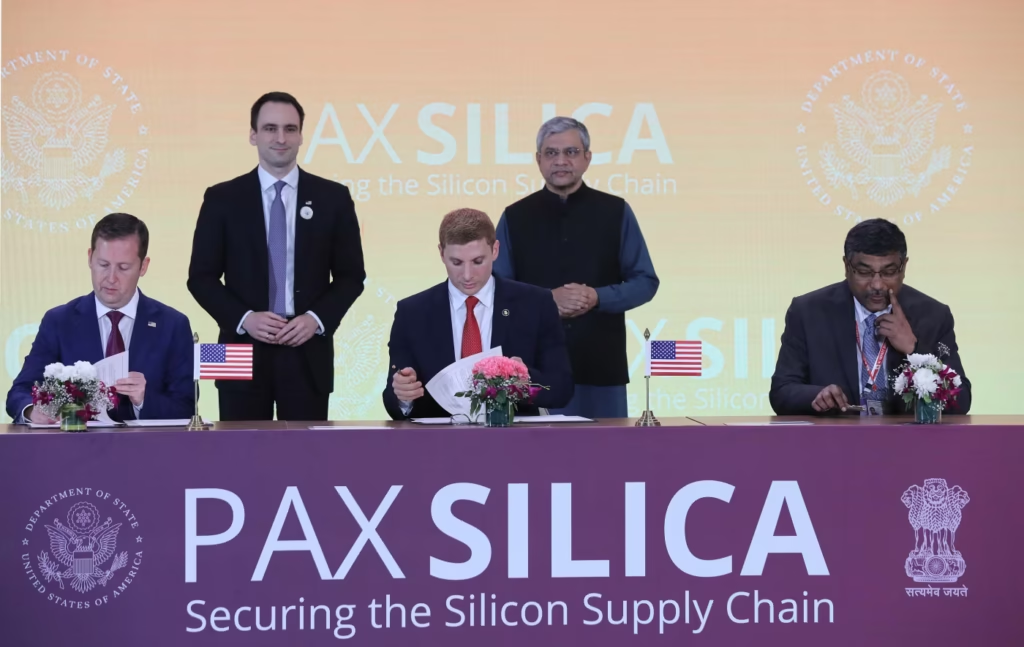
In a defining moment for India’s global tech positioning, the nation has officially become the 10th full signatory to the Pax Silica Declaration—a landmark agreement that promises to reshape the architecture of the global semiconductor and AI ecosystem.
The formal signing took place on February 20, 2026, during the historic India AI Impact Summit in New Delhi. The agreement was inked by Shri S. Krishnan, Secretary of India’s Ministry of Electronics and IT (MeitY), alongside US Ambassador to India Sergio Gor and Under Secretary of State for Economic Affairs Jacob Helberg .
This accession places India at the heart of a “trusted” and innovation-driven alternative to concentrated dependencies in the global silicon stack—from raw minerals to frontier AI models—and marks a strategic convergence between the world’s largest democracy and one of its fastest-growing technology ecosystems .
What Is Pax Silica?
Launched in December 2025 in Washington, D.C., Pax Silica is a multilateral initiative coordinated by the US Department of State aimed at building resilient, secure, and collaborative networks across the entire technology value chain .
Founding Members (Pre-India)
- Australia
- Israel
- Japan
- Qatar
- Republic of Korea (South Korea)
- Singapore
- United Arab Emirates
- United Kingdom
- United States
With India’s inclusion, the alliance now represents a powerful bloc of nations committed to:
- Supply chain security for semiconductors and critical minerals
- Trusted AI development aligned with democratic values
- Open innovation while managing risks
- Diversified sourcing reducing dependency on any single geography
The Name
“Pax Silica” evokes the idea of a stable, cooperative order built around silicon—the foundational material of the digital age. Like the Pax Romana or Pax Britannica, it suggests a framework for prosperity through shared rules and mutual benefit, rather than dominance through coercion .
What India’s Membership Means
India’s accession to Pax Silica is not merely symbolic—it carries concrete implications across multiple dimensions of technology policy and industrial development.
1. Semiconductor Supply Chain Security
India has ambitious goals under its India Semiconductor Mission:
- Building domestic chip design capabilities
- Establishing assembly, testing, marking, and packaging (ATMP) facilities
- Eventually scaling to fabrication (fabs)
Pax Silica membership accelerates these goals through:
Enhanced Cooperation:
- Process know-how sharing from advanced semiconductor ecosystems
- Equipment access for fabrication and testing (companies like ASML, Applied Materials, Lam Research)
- Partnerships with leading firms (Micron, Qualcomm, Intel, TSMC)
- Critical minerals processing expertise for rare earths and specialized materials
Risk Reduction:
- Diversified sourcing reduces vulnerability to supply disruptions
- Coordinated stockpiling and emergency response mechanisms
- Shared intelligence on supply chain threats
2. AI Ecosystem Alignment
India’s AI ambitions—showcased dramatically at the same summit through Sarvam AI’s 105B model launch and Yotta’s $2 billion supercluster—now have an international framework for cooperation:
Key Focus Areas:
- Pro-innovation regulations that balance growth with safety
- Secure and trusted AI development practices
- Open access to advanced technologies among member nations
- Democratic governance of AI systems
- Ethical standards aligned with shared values
This complements India’s own New Delhi Frontier AI Impact Commitments (announced just days earlier) and PM Modi’s MANAV Vision for ethical, inclusive AI .
3. Geopolitical and Economic Signaling
India’s inclusion in Pax Silica carries profound strategic significance:
A BRICS Member Joins a US-Led Bloc
As a founding member of BRICS with deep ties to the Global South, India’s participation bridges traditionally distinct geopolitical groupings. This signals that technology cooperation need not be zero-sum—nations can collaborate on shared challenges while maintaining diverse diplomatic relationships.
Strategic Convergence with the US
Coming amid warming India-US ties following adjustments in tariff and energy trade policies, this agreement deepens bilateral technology cooperation that has been growing for decades.
Global South Leadership
India’s voice within Pax Silica ensures that the perspectives of emerging economies are represented in shaping rules and standards for technologies that will affect billions.
4. Talent and Market Access
For Indian startups and enterprises, Pax Silica membership opens doors:
Faster Access to:
- Process know-how from advanced semiconductor ecosystems
- Equipment and materials for manufacturing
- GPUs and advanced compute for AI development
- Partnership opportunities with global technology leaders
Enhanced Credibility:
- Indian companies become part of “trusted” supply chains
- Compliance with Pax Silica standards signals reliability
- Easier cross-border collaboration with member-nation firms
5. Critical Minerals and Rare Earths
India possesses significant reserves of rare earth elements and other critical minerals essential for semiconductor manufacturing, advanced electronics, and clean energy technologies. Pax Silica membership positions India as a key node in diversified, non-coercive global supply chains for these strategic resources.
The Broader Context: India’s AI and Semiconductor Momentum
India’s Pax Silica accession doesn’t happen in isolation. It builds on and amplifies extraordinary domestic momentum:
Recent Milestones (All from February 2026)
| Announcement | Significance |
|---|---|
| Sarvam AI 105B model | India’s most powerful foundational model, outperforming global giants on Indic benchmarks |
| Yotta $2 billion supercluster | 20,736 NVIDIA Blackwell GPUs, dramatically expanding domestic compute capacity |
| NVIDIA-AIGI partnership | Catalyzing 10,000+ builders and 500+ AI ventures |
| IN-SPACe ₹6 crore seed fund | Supporting space-AI convergence startups |
| PM Modi’s MANAV Vision | Ethical framework for AI governance |
| New Delhi AI Commitments | Global principles for responsible frontier AI |
| Livspace AI restructuring | Consumer-tech embracing AI transformation |
| Peak XV $1.3 billion fund | Massive venture capital commitment |
| CS Tech AI NSE listing | Deep-tech infrastructure goes public |
| Infiheal AI FOR ALL win | Mental health AI recognized nationally |
India Semiconductor Mission Targets
- $200 billion data centre investment targets
- Multiple ATMP units under establishment
- Design-linked incentive schemes attracting global players
- Skilling programs for semiconductor workforce
AI Infrastructure Push
- Yotta’s supercluster (20,736 GPUs) going live August 2026
- Government compute subsidies under IndiaAI Mission
- Private sector investments from Reliance, Adani, and others
Pax Silica membership provides the international framework within which these domestic efforts can scale and integrate with global partners .
What US Officials Said
At the signing ceremony, US officials emphasized the strategic importance of India’s participation:
Jacob Helberg, Under Secretary of State for Economic Affairs:
“India’s participation in Pax Silica is strategic and essential. With one of the world’s largest tech talent pools, a vibrant startup ecosystem, and ambitious semiconductor goals, India brings capabilities and perspectives that strengthen the entire alliance. This isn’t about countering any single power—it’s about building collaborative, resilient networks that power innovation for the future.”
Sergio Gor, US Ambassador to India:
“The partnership between our nations has never been stronger. From defense to technology to energy, we are building a comprehensive relationship that benefits both our peoples. Pax Silica represents the next frontier of this partnership—working together to ensure that the technologies shaping our future are developed securely, ethically, and collaboratively.”
Shri S. Krishnan, Secretary, MeitY:
“India’s accession to Pax Silica reflects our commitment to building a trusted, resilient, and innovative technology ecosystem. As we pursue our Semiconductor Mission and AI ambitions, this partnership provides a framework for cooperation with like-minded nations. We look forward to contributing our strengths—from talent to rare earths to entrepreneurial energy—to this shared endeavor.”
Implications for Indian Startups and Industry
For Indian technology companies, Pax Silica membership translates into tangible opportunities:
Semiconductor Startups
- Access to global supply chains for materials and equipment
- Partnership opportunities with established players
- Credibility for fundraising and customer acquisition
- Talent exchange programs with member nations
AI and Deep-Tech Startups
- Faster access to advanced compute through coordinated frameworks
- Collaborative R&D opportunities with member-nation institutions
- Regulatory alignment reducing cross-border compliance burden
- Market access to other Pax Silica economies
Established Enterprises
- Supply chain diversification options
- Technology partnerships with global leaders
- Standards alignment simplifying international operations
- Talent mobility across member nations
Investors
- Clarity on regulatory frameworks across member nations
- Cross-border investment corridors with reduced friction
- Confidence in long-term policy stability
- Exit options across multiple markets
The Geopolitical Context: A Shifting Global Order
Pax Silica must be understood within the broader evolution of global technology governance:
Beyond Zero-Sum Thinking
US officials explicitly framed Pax Silica as not about countering any single power but about building collaborative networks. This reflects a shift from purely competitive framing toward positive-sum cooperation among like-minded nations.
The Rise of “Tech Alliances”
Traditional military and economic alliances are being supplemented by technology-specific frameworks. Pax Silica joins:
- Quad (Quadrilateral Security Dialogue)
- AUKUS (Australia-UK-US security pact)
- IPEF (Indo-Pacific Economic Framework)
- Chip 4 (semiconductor cooperation)
Each addresses different dimensions of technology cooperation, with Pax Silica focused specifically on the full silicon stack from minerals to models.
India’s Unique Position
As both a Pax Silica member and a BRICS founder, India occupies a distinctive position. This enables:
- Bridge-building between groupings
- Voice for Global South in technology governance
- Model for multi-alignment in a complex world
The Values Dimension
Pax Silica explicitly ties technology cooperation to democratic governance, ethical standards, and shared values. This values-based approach distinguishes it from purely transactional arrangements and creates a framework for addressing concerns about AI safety, human rights, and digital authoritarianism.
What This Means for India’s Global Tech Ambitions
India’s accession to Pax Silica represents a significant elevation of its role in global technology governance:
From Participant to Core Player
For decades, India has been a participant in global technology systems shaped elsewhere. Pax Silica positions India as a core player in designing the next generation of those systems.
From Market to Partner
Global technology companies have long viewed India as a market—a place to sell products and access talent. Pax Silica signals a shift toward viewing India as a partner in building the future of technology itself.
From Follower to Shaper
In standards-setting, supply-chain design, and governance frameworks, India now has a seat at tables where the rules are written. This enables Indian perspectives—on inclusion, affordability, linguistic diversity, and development—to shape global norms.
From Dependent to Resilient
By joining a trusted network of technology partners, India reduces its exposure to supply chain disruptions, coercive dependencies, and technology decoupling risks. Resilience becomes built into the system, not an afterthought.
Challenges Ahead
While Pax Silica membership brings opportunities, challenges remain:
Implementation Complexity
Translating high-level agreements into operational cooperation requires sustained effort across multiple agencies and industries.
Balancing Relationships
India must navigate its diverse international partnerships—with Pax Silica members, BRICS partners, and others—without creating unnecessary tensions.
Domestic Capacity
To fully leverage Pax Silica, India must continue building domestic capabilities in semiconductor design, fabrication, AI research, and critical minerals processing.
Standards Alignment
Harmonizing Indian standards with Pax Silica frameworks will require regulatory evolution and industry adaptation.
Talent Development
The semiconductor and advanced AI workforce needs to expand dramatically to meet growing demand.
Conclusion: India’s Place in the Silicon Future
The signing of the Pax Silica Declaration on February 20, 2026, at the India AI Impact Summit marks a watershed moment for India’s technology trajectory. By joining this alliance of trusted, innovation-driven nations, India has:
- Secured its place in the global semiconductor supply chain
- Aligned its AI ambitions with like-minded partners
- Deepened its strategic partnership with the United States and other key nations
- Positioned itself as a bridge between the Global North and South
- Gained a voice in shaping the rules for technologies that will define the 21st century
For Indian startups, enterprises, and researchers, this translates into tangible opportunities: faster access to advanced technologies, clearer pathways to global markets, and a framework for collaboration with the world’s most innovative companies.
For the global technology ecosystem, India’s inclusion brings one of the world’s largest talent pools, fastest-growing markets, and most dynamic startup ecosystems into a collaborative framework for building resilient, secure, and ethical technology supply chains.
As US officials noted, this is “not about countering any single power—it’s about building collaborative, resilient networks that power innovation for the future.”
India is now a core part of that future.