
India’s Private Space Sector Poised for 30x Growth: A $40 Billion Market by 2035
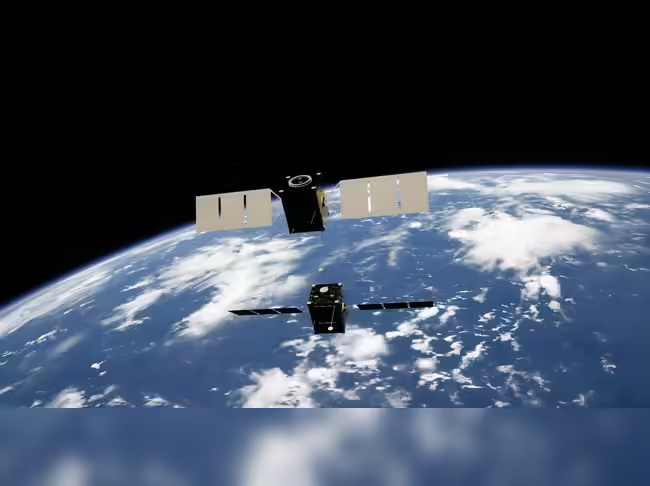
A seismic shift is underway in the final frontier, and India is poised to be at its epicenter. A major new report forecasts the country’s private space sector to explode into a $40 billion market by 2035, a staggering 30x growth from its current ~$1.5 billion valuation. This projection cements India’s trajectory from a nation celebrated for its cost-effective public space program to a global commercial space powerhouse, driven by a dynamic, innovative private ecosystem.
The forecast is not mere speculation but a data-backed validation of the transformative reforms unleashed since 2020. The liberalization spearheaded by IN-SPACe, coupled with surging global demand and homegrown entrepreneurial genius, is creating a perfect launchpad for what could become one of the world’s most vibrant space economies.
The Engines of Hyper-Growth: A Multi-Orbit Strategy
India’s private space ascent is being powered by four synergistic verticals, each representing a multi-billion-dollar opportunity:
- Satellite Services & Constellations (The Data Goldmine): This is the immediate revenue driver. Companies like Pixxel (hyperspectral), SatSure (AI analytics), and PierSight (SAR) are building sovereign data infrastructure. The recent Pixxel-led ₹1,200 crore national EO constellation PPP is a landmark proof point, showcasing how private players are now trusted to build and operate strategic national assets. Demand for high-frequency, customized Earth Observation data for agriculture, climate monitoring, urban planning, and defense is insatiable.
- Launch Vehicles (The Access Revolution): The rise of private launch providers like Agnikul Cosmos and Skyroot Aerospace is democratizing access to space. Their focus on small and medium-lift rockets caters to the booming global demand for dedicated, on-demand launches for small satellite constellations—a market largely underserved by traditional, heavy-lift providers. Success here will make India a global hub for affordable launch services.
- Propulsion & In-Space Technologies (The Deep-Tech Core): The real moat is being built here. Startups are pioneering advanced electric propulsion, green propellants, and in-space manufacturing. This segment represents the high-value, intellectual property-dense core of the sector, moving India up the value chain from assembly to creating cutting-edge, exportable space-grade technology.
- Downstream Applications (The Value Unlock): The ultimate economic impact. AI-powered geospatial analytics will transform sectors worth trillions—from precision agriculture and insurance to disaster resilience and national security. This downstream market will be many times larger than the upstream launch and manufacturing sector, creating massive value and jobs on the ground.
The Catalysts: Policy, Demand, and Capital
This explosive growth is underpinned by a powerful trifecta:
- Policy Liberation as Rocket Fuel: The establishment of IN-SPACe as a single-window facilitator, ISRO’s unprecedented technology transfer and facility sharing, and anticipated production-linked incentives (PLI) for the space sector have dismantled decades of barriers. The government is now an anchor customer and enabler, not a gatekeeper.
- Soaring Global & Domestic Demand: The global space economy is expanding rapidly, with a clear need for low-cost, reliable sovereign alternatives. Domestically, nearly every ministry—from Agriculture to Defence—is now a potential customer for space-based data and services, creating a massive anchor demand.
- Investor Confidence Reaching Escape Velocity: Milestones like successful private suborbital tests, major PPPs, and global contracts have de-risked the sector for investors. From venture capital to strategic corporate funding, capital is now flowing into spacetech with the conviction that it is the next deep-tech frontier.
The 2030 Vision: A Top-Five Global Power
The report predicts a 25-30% CAGR for the sector through this decade. By 2030, India is expected to rank among the top five global private space markets. This will translate into:
- Thousands of high-skill jobs in engineering, data science, and advanced manufacturing.
- A self-reliant (Atmanirbhar) end-to-end space ecosystem, from component manufacturing to data delivery.
- Indian startups as global acquirers and leaders, not just domestic players.
Challenges on the Horizon: Navigating the Vacuum
The path has hurdles: securing consistent long-term capital for R&D-heavy models, navigating complex international regulations and export controls, and competing with heavily subsidized Western rivals. Sustaining the momentum will require continued policy stability, easier access to debt financing, and fostering more industry-academia collaboration.
Conclusion: A Giant Leap for India’s Commercial Ambition
The $40 billion forecast is more than a number; it is a declaration of a new economic paradigm. India is no longer content with being a participant in humanity’s space journey; it is determined to be a leading architect of its commercial future.
The stars have indeed aligned. With visionary entrepreneurs, enabling policy, and a vast market, India’s private space sector is ready for liftoff. This journey will not only create wealth but will also provide the strategic intelligence and technological edge to solve pressing earthly challenges, securing India’s place as a true 21st-century space power.
Stay tuned to Startup Point for in-depth coverage of the startups, deals, and policies propelling India’s rise as a space-tech leader.