A Setback, Not a Stop: Analyzing the PSLV-C62 Anomaly and the Resilience of India’s Space-Tech Ambition
The silence that followed the PSLV-C62 mission’s anomaly was palpable. On a day meant to showcase the burgeoning strength of #NewSpaceIndia, a deviation in the rocket’s third stage resulted in the loss of its entire payload: 16 satellites representing years of innovation, investment, and ambition from India’s private space sector. This incident is undeniably a significant setback, but to understand its true impact, we must look beyond the immediate loss to the ecosystem’s inherent resilience and the critical lessons it must now absorb.
The Weight of the Loss: More Than Hardware
The PSLV-C62 mission was a landmark rideshare, a testament to ISRO’s role as a launchpad for private ambition. The payloads lost were not merely satellites; they were pioneers carrying the dreams of a new generation of space builders:
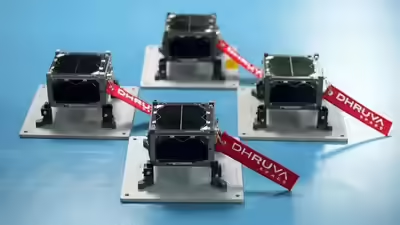
- For Hyderabad-based Dhruva Space, the loss included multiple satellite deployers and the Thybolt-3 cubesat, a blow to a company at the forefront of making space accessible.
- TakeMe2Space saw its mission vanish, a delay in its journey to democratize space access.
- Eon Space Labs suffered a particularly cutting setback, losing the MOI-1 AI orbital lab and the MIRA telescope. These payloads were set to demonstrate groundbreaking advancements in #OrbitalAI and onboard data processing—key technologies for the future of intelligent, affordable space operations.
This failure delays crucial technology demonstrations, disrupts timelines, and, most acutely, validates the persistent concerns about launch reliability for private players whose fortunes are tied to the availability and success of ISRO’s rideshare slots.
The Crucial Question of Launch Dependence
The incident brings a long-simmering debate to the forefront: the risks of concentrated launch dependence. For all its cost-effectiveness and historic reliability, the PSLV remains a single point of potential failure for a rapidly multiplying number of private missions. This anomaly underscores the urgent need for the ecosystem to diversify its pathways to orbit. It is a stark argument for accelerating the development of fully private launch vehicles in India and for startups to strategically engage with international launch providers to de-risk their manifest schedules.
Resilience in the DNA: Analysis Over Alarm
However, to declare this a crisis would be to misunderstand the nature of space exploration and the character of India’s space community. Setbacks are encoded in the science of rocketry. ISRO’s own history—from early failures to the triumphant Chandrayaan-3 recovery—is a masterclass in resilience. The agency’s strength has never been a perfect record, but its meticulous, transparent approach to Failure Mode Analysis.
Already, detailed investigations are underway. This rigorous post-anomaly process, which will dissect every shred of data from the third-stage performance, is what builds future success. The lessons learned from C62 will directly inform improvements for C63 and beyond, enhancing reliability for all future public and private payloads.
The Path Forward: Building Back with Greater Resolve
For the affected #SpaceStartups, the path is undeniably harder. They must now navigate investor conversations, recalibrate roadmaps, and rebuild hardware. Yet, the very existence of these companies—their technical depth and entrepreneurial spirit—is the best proof that the ecosystem is maturing.
This moment should catalyze three key developments:
- Strengthened Public-Private Partnership: Deeper collaboration on quality assurance, integration processes, and risk-sharing models between ISRO and its private partners.
- Accelerated Launch Alternatives: Renewed policy and investment focus on enabling competing private launch solutions within India.
- Ecosystem-Wide Maturity: A shift from seeing ISRO purely as a service provider to engaging as a collaborative engineering partner in mission assurance.
Conclusion: A Sobering Milestone on a Long Journey
The #PSLVFailure is a sobering milestone, but it is not an end point. The journey to build a world-class, #PrivateSpace ecosystem in India is a hard-tech marathon, not a sprint. It is paved with both spectacular successes and instructive failures.
The true test for #StartupIndia in space is not whether it faces setbacks, but how it responds. The response now must be one of determined analysis, strategic adaptation, and unwavering commitment to building back better. The satellites may have been lost, but the mission—to make India a leading space-faring nation through public genius and private enterprise—remains firmly on course.