
IIT Madras Goes Global: A Strategic Play to Anchor Indian Deep-Tech on the World Stage
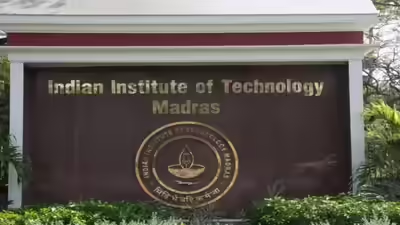
In a landmark move that signals a new era for Indian academic and technological ambition, IIT Madras has announced a bold plan to establish international offices in five key nations. This strategic expansion is not merely about administrative presence; it is a calculated mission to commercialize sovereign Indian innovation, forge unprecedented cross-border partnerships, and position India as a primary exporter of deep-tech solutions. The targeted countries—Singapore, the United States, the United Kingdom, Germany, and Japan—represent a deliberate choice: they are global powerhouses of innovation, capital, and advanced industry with tangible demand for the cutting-edge technologies emerging from Chennai’s premier institute.
The “Why Now”: From Incubation to Internationalization
IIT Madras is building on a formidable foundation. With over 500 deep-tech startups incubated having raised a collective $2+ billion in funding, the institute has proven its ability to translate academic research into viable, high-impact ventures. The logical next step is to systematically scale these innovations beyond India’s borders. As articulated by Prof. V. Kamakoti, Director of IIT Madras, this initiative transcends traditional academic exchange: “We are not just exporting talent or ideas — we are taking sovereign Indian innovations to solve global problems, while bringing the world’s best minds to collaborate with us.”
This vision marks a paradigm shift from a brain-drain narrative to a “brain-gain and technology-export” model, perfectly aligning with the Atmanirbhar Bharat doctrine of creating and owning globally competitive intellectual property.
The Strategic Blueprint: More Than Just Offices
These international nodes are designed to be multifunctional engines driving several critical objectives:
- Technology Commercialization & Licensing: Acting as a bridgehead to facilitate technology transfer from IIT Madras labs and its incubated startups to global corporations, generating revenue and validating the global applicability of Indian R&D.
- Market Access for Startups: Providing a physical launchpad and on-ground support for IITM-incubated startups to navigate foreign regulatory landscapes, secure pilot customers, and attract international venture capital.
- R&D Collaboration & Talent Attraction: Deepening existing ties and forging new strategic partnerships with top global universities (like MIT, NUS, Oxford) and corporates for joint research projects, while also attracting world-class PhDs, post-docs, and faculty to engage with India’s ecosystem.
- Joint Accelerator Programs: Co-creating accelerator and mentorship programs with international VCs and corporates, focusing on sectors like AI, quantum computing, robotics, biotech, and sustainability tech—areas where IIT Madras has demonstrated strength and the target countries have acute need.
The Global Context and Competitive Edge
This expansion arrives at a pivotal moment. Globally, there is intense competition for leadership in critical technologies. By planting its flag in these five nations, IIT Madras is ensuring that Indian innovations are not siloed but are integrated into the world’s most advanced industrial and research value chains. The offices will serve as permanent listening posts and collaboration hubs, ensuring India is a co-creator in solving global challenges, from climate tech to next-generation computing.
A Game-Changer for the Indian Startup Ecosystem
For Indian deep-tech founders, particularly those emerging from the IIT Madras ecosystem, this is a transformative development. Scaling a deep-tech venture internationally is fraught with challenges—from understanding niche markets to building credibility with global clients. These offices will act as a trusted “soft-landing zone,” dramatically de-risking the global expansion process and allowing startups to “go global without losing their roots.”
This initiative also sends a powerful signal to global investors: Indian deep-tech is not a regional play but a source of world-class, investable technology ready for global scaling. It reinforces the credibility built by the institute’s track record, from the success of companies like AgniKul Cosmos and Detect Technologies to its leadership in the IndiaAI Mission.
By mid-2026, when the first offices become operational, the institute will have cemented a new model for how Indian academia can proactively shape the global technology landscape. IIT Madras is not waiting for the world to come to it; it is strategically placing itself at the world’s most influential tables. This is more than an expansion; it is a declaration of India’s arrival as a deep-tech superpower.