
BSNL’s Indigenous 4G Stack: 1 Lakh Towers Active, Export-Ready, and a ₹20,000 Crore Capex Bet
In the world of telecommunications, speed to market has traditionally been everything. Private players like Reliance Jio and Bharti Airtel rolled out 4G networks years ago and have since moved on to 5G. For a long time, the question hung in the air: why was BSNL, the state-owned telecom giant, lagging so far behind?
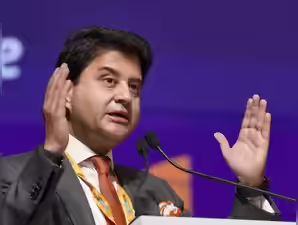
On March 26, 2026, Communications Minister Jyotiraditya Scindia provided the definitive answer. The delay, he explained, was not a failure of execution but a deliberate strategic choice: India chose to build its own 4G technology stack from scratch rather than buy it from foreign vendors .
“The reason why the rollout of 4G has taken time is because we chose to develop our own stack. Countries across the world haven’t done it. India did it in 22 months,” Scindia said at the Times Now Summit .
Today, that bet is paying off. Nearly 1 lakh (98,000) towers are currently radiating 4G signals using this homegrown technology . BSNL has placed purchase orders for one lakh 4G sites under the Atmanirbhar Bharat initiative, with supply beginning in September 2023 . As of mid-January 2026, 97,672 sites had been installed, with 95,511 already radiating .
The Bharat Telecom Stack: Who Built It?
The “Made in India” 4G stack is not the product of a single entity. It is the result of a strategic partnership between India’s leading technology institutions and private players .
- Tata Consultancy Services (TCS): The integration partner, responsible for bringing the stack together and ensuring interoperability. TCS also provides the Cognitive Network Operations Platform (CNOPS) for 24/7 monitoring .
- Centre for Development of Telematics (C-DOT): India’s premier telecom R&D center, which developed the core network (EPC) applications .
- Tejas Networks: Provided the Radio Access Network (RAN), including base stations and radio infrastructure across 100,000 sites .
This consortium model ensured that every layer of the network—from the radio waves to the core software—was developed on Indian soil. As A Robert J Ravi, CMD of BSNL, stated, “This is a monumental achievement for national pride… The ‘Made in India’ Stack brought to life by the relentless dedication of team BSNL secures our digital future” .
Going Beyond 4G: The 5G Roadmap and Export Ambitions
One of the most critical aspects of this indigenous stack is that it is 5G-ready. Unlike previous infrastructure that required hardware swaps, BSNL’s network is built to upgrade to 5G primarily through software updates .
Minister Scindia outlined the immediate roadmap:
- Expansion: BSNL will add another 50,000-60,000 towers to build a robust network .
- Transition to 5G: Once the expanded network is stable, BSNL will “very quickly switch to 5G” .
Perhaps more significantly, Prime Minister Narendra Modi declared at the India Mobile Congress (IMC) 2025 that India’s indigenous 4G stack is now “export ready” . This positions India among a select group of nations (China, Sweden, Finland, South Korea) capable of manufacturing and deploying their own telecom equipment, opening up new opportunities for Indian telecom equipment manufacturers to compete in global markets .
The Financial Turnaround: From Losses to Profits
The investment in indigenous technology is massive. Scindia revealed that BSNL undertook the highest capital expenditure in its history in the last year—close to ₹20,000 crore . While such large-scale investments led to significant depreciation costs initially, they are now yielding results.
BSNL posted a quarterly profit of ₹262 crore after an 18-year gap .
- FY24 Operating Profit (EBITDA): ₹2,395 crore
- FY25 Operating Profit (EBITDA): ₹5,100 crore
- FY26 Projection: Double-digit growth from the FY25 figure
The subscriber base has also grown, from 8.86 crore in March 2024 to 9.28 crore by December 2025 .
Why This Matters for Startups
For India’s startup ecosystem, BSNL’s indigenous stack is a massive opportunity. It signals a shift toward domestic R&D and commercialization, creating a fertile ground for collaboration between public sector giants and agile startups .
Opportunities across the Telecom Innovation Spectrum:
- Hardware Ecosystems: With the government committed to domestic telecom equipment manufacturing, startups can play a role in creating components, antennas, and IoT devices that integrate with BSNL’s network.
- Network Optimization Tools: The CNOPS platform opens doors for startups to build specialized SaaS solutions for network analytics, predictive maintenance, and energy efficiency.
- Indigenous SaaS Solutions: As BSNL modernizes, there is a growing need for homegrown software solutions tailored to the Indian telecom landscape.
- Telecom Technology Development Fund (TTDF): The government is actively supporting startups developing 5G and IoT technologies through grants. The Telecommunication Engineering Centre (TEC) offers reimbursement for testing and certification costs for telecom startups and MSEs, with funding up to Rs 50 lakhs per entity .
The Strategic Imperative: Sovereignty and Security
Beyond connectivity and economics, this move is fundamentally about strategic technological sovereignty . By reducing reliance on foreign vendors (a vulnerability highlighted by global supply chain disruptions), India is securing its digital infrastructure.
As the network expands to cover 26,700 additional villages previously lacking high-speed connectivity, it empowers citizens with access to online education, telemedicine, digital payments, and e-governance . “Faster and more reliable mobile internet will enhance digital payments, online shopping, and streaming services,” noted a BSNL release, emphasizing the boost for local businesses and startups .
The Road Ahead
The journey of BSNL’s 4G stack is a testament to India’s engineering capabilities and strategic foresight. While the path took longer than expected, the destination promises a secure, self-reliant, and digitally inclusive India.
For startups and entrepreneurs, the message is clear: the government is building the foundational infrastructure; now it is up to the private sector to build the applications, services, and innovations that will ride on top of it. BSNL’s network is not just a telecom upgrade; it is a platform for the next generation of Indian innovation