
AI in Filmmaking Takes Centre Stage at Nagpur Film Festival: 80-90% Cost Reduction, but Storytelling Remains Human
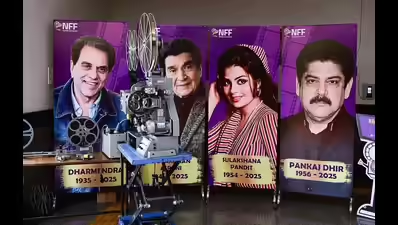
The 2026 Nagpur Film Festival was expected to be a celebration of cinema—a gathering of storytellers, cinephiles, and industry veterans. What no one anticipated was the extent to which the festival would become a showcase for a different kind of disruption: the quiet but profound integration of artificial intelligence into the art and business of filmmaking.
In a workshop titled “AI in Filmmaking: Efficiency vs. Essence,” startup founders from across India demonstrated how AI tools are fundamentally altering production economics, offering cost reductions of up to 80–90% in key workflows . From automating the drudgery of editing to generating complex visual effects and streamlining pre-production planning, the message was clear: AI is no longer a futuristic promise—it is a present-day reality reshaping how films are made.
Yet, as the demonstrations gave way to discussion, a more nuanced picture emerged. The industry experts and filmmakers on the panel were united on one point: while AI could handle the mechanics, the soul of cinema—storytelling, emotional depth, and creative vision—remains irreplaceably human.
The Workshop: A Glimpse into the AI-Powered Production Pipeline
The workshop, held on the festival’s second day, brought together a diverse group of participants: independent filmmakers, students, VFX artists, and technology founders . The startups on display ranged from those building specialized AI models for script analysis to platforms automating post-production workflows.
One demonstration showed an AI tool ingesting a rough cut and generating multiple edit sequences based on different narrative styles—a process that would typically take a human editor days, compressed into minutes . Another startup showcased an AI-powered VFX platform that could generate complex digital environments and characters at a fraction of the cost of traditional CGI studios, with real-time rendering capabilities that allow directors to see effects in-camera during shooting .
A third platform automated pre-production logistics: scheduling, budgeting, location scouting, and even generating shot lists from a script. The founder claimed the tool could reduce pre-production time by up to 75% , allowing filmmakers to move from script to shoot in weeks rather than months .
The cumulative effect was striking. As one attendee put it, “What used to require a team of 20 and a budget in crores can now be done by a small team with a fraction of the cost.”
The Cost Question: 80–90% Reduction Claims
The most provocative claim to emerge from the workshop was the assertion that AI tools could reduce production costs by 80–90% in certain workflows. While this figure was presented as a potential rather than a universal guarantee, the examples cited were compelling.
Visual Effects (VFX): Traditionally one of the most expensive components of filmmaking, VFX production can be accelerated and made more affordable through AI-powered rotoscoping, compositing, and rendering. One startup demonstrated generating a fully rendered CGI character for one-tenth the cost of traditional methods, with rendering times reduced from days to hours.
Editing and Post-Production: AI tools that automate rough cuts, sync audio, and even suggest color grading options can reduce the hours editors spend on initial passes. One founder estimated that AI could handle 70–80% of the mechanical work in post-production, allowing editors to focus on creative decisions.
Pre-Production Planning: Script breakdown, scheduling, and budgeting tools powered by AI can reduce the time and labor required in the planning phase. One platform claimed to reduce pre-production costs by up to 85% , though this was caveated as dependent on the complexity of the project.
Music and Sound: AI-generated scores and sound effects are becoming increasingly sophisticated, offering indie filmmakers access to high-quality audio without the expense of hiring composers or sound studios.
The Human Element: Storytelling and Emotional Depth
As impressive as the demonstrations were, the panel discussions quickly pivoted to a more fundamental question: What happens to the art of cinema when the tools of production become automated?
The consensus among the filmmakers and industry experts was nuanced. Veteran director Ashwini Iyer, who participated in the panel, noted: “Technology has always changed filmmaking—from sound to color to digital cameras. But what has never changed is the need for a human voice, a human perspective. AI can help us make films, but it cannot tell us what films to make.”
Another panelist, a startup founder building AI tools for script analysis, offered a complementary view: “We’re not trying to replace writers or directors. We’re trying to give them more time to do what they do best. If AI can handle the spreadsheets, the schedules, the technical grind, then the creative team can focus entirely on story and performance.”
The discussion touched on the fear that AI might homogenize cinema, producing content optimized for algorithms rather than audiences. But the counter-argument was equally strong: AI, when used thoughtfully, could democratize access to high-quality production, enabling independent creators and regional storytellers to compete on a larger stage.
A New Frontier for Indian Startups
The Nagpur Film Festival workshop was significant not only for what it revealed about AI in filmmaking but also for what it said about the expanding ambitions of India’s startup ecosystem. Startups that once focused on fintech, edtech, or enterprise SaaS are now applying their skills to the creative industries.
The AI tools on display at the festival were built by Indian teams, for Indian conditions—addressing the specific constraints of independent filmmakers working with limited budgets, tight schedules, and a desire to tell stories that resonate with local audiences .
This mirrors a broader trend: AI is becoming a cross-industry disruptor, enabling startups to reimagine legacy industries with new models of affordability and accessibility. From healthcare and agriculture to education and entertainment, the application layer of AI is being built in India, by Indian founders, for global markets.
The Road Ahead: Democratizing Production
For independent and regional filmmakers, the implications of AI-powered production are profound. The cost reductions demonstrated at the workshop could lower the barrier to entry for first-time directors, documentary makers, and storytellers from smaller cities and towns .
As one participant noted, “The biggest challenge for a first-time filmmaker is not lack of talent. It’s lack of resources. If AI can bridge that gap, we will see stories we’ve never seen before—stories that have been waiting for someone to tell them.”
The workshop concluded with a call for greater collaboration between technologists and filmmakers. The tools are here; the question now is how they will be used. As the panelists agreed, the most exciting possibilities lie not in replacing human creativity but in amplifying it.
The Final Word
The Nagpur Film Festival’s AI workshop was a snapshot of a moment in transition. The technologies on display are already reshaping how films are made, offering cost reductions that could democratize access to high-quality production. But the conversations that followed were a reminder that technology is only one part of the equation.
In the end, cinema remains what it has always been: a medium for human stories, told by human voices, felt by human hearts. AI can help tell those stories more efficiently, more affordably, and perhaps even more imaginatively. But it cannot replace the storyteller.
For Indian startups, the challenge is to build tools that empower creators without constraining them. For filmmakers, the opportunity is to embrace new technologies while holding fast to the essence of their craft. And for audiences, the promise is a richer, more diverse cinematic landscape—one where more stories, from more voices, have the chance to be told.