
The 50% Story: How Small-Town India Became the Unexpected Engine of India’s Startup Revolution
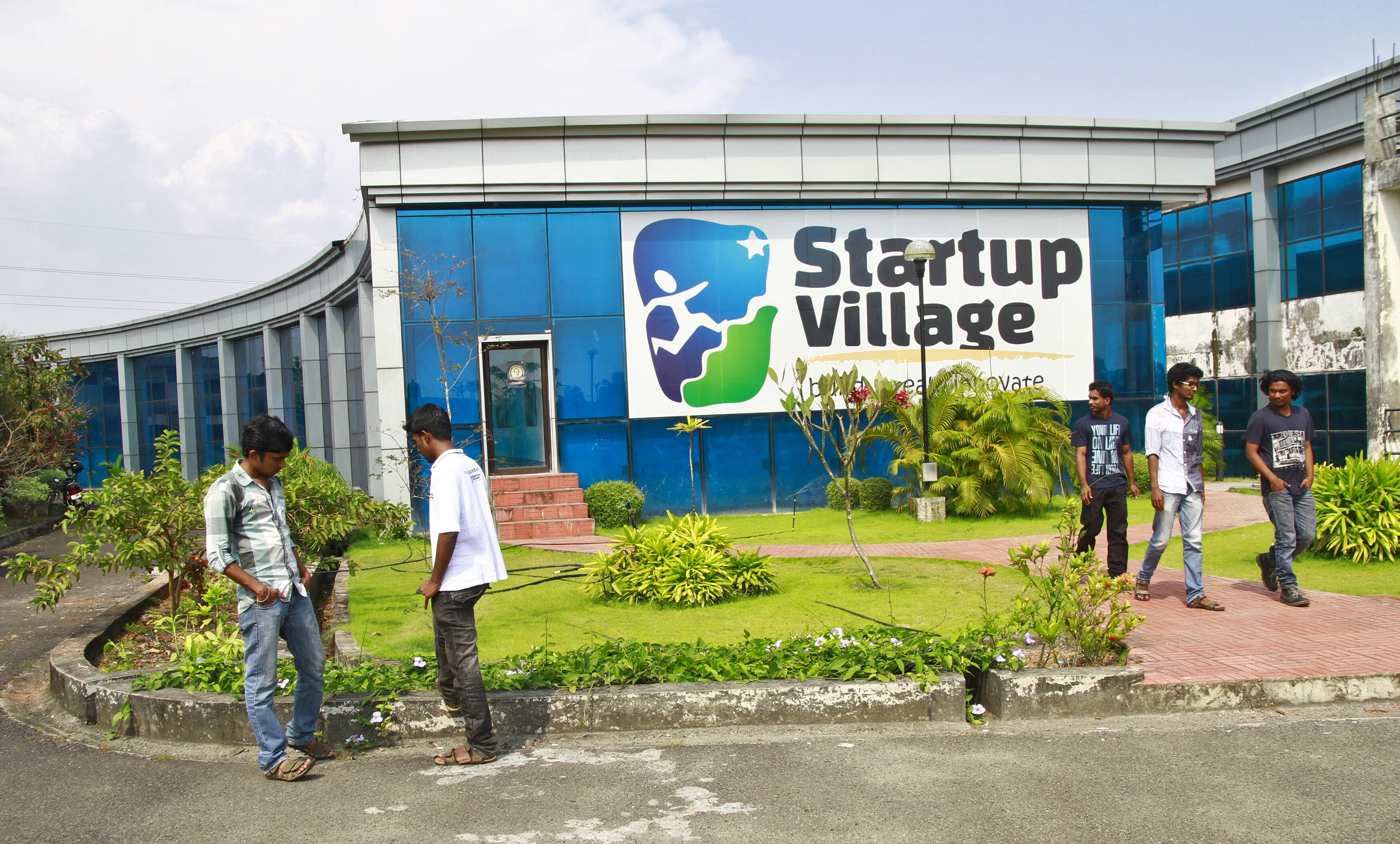
For nearly two decades, the Indian startup story had a predictable geography. If you wanted to build a technology company, you went to Bengaluru, Delhi NCR, or Mumbai. The narrative was simple, the capital was concentrated, and the talent followed the money. That era is ending. Today, nearly 50 percent of all DPIIT-recognised startups originate from Tier-2 and Tier-3 cities, a remarkable shift from a decade ago when the country’s innovation economy was overwhelmingly concentrated in a handful of metros.
This is not a minor adjustment in the data. It is a structural reorganisation of how innovation happens in India.
The Numbers That Changed Everything
BlogThe scale of this transformation is best captured in the data. Over 200,000 startups are now recognised by the Department for Promotion of Industry and Internal Trade (DPIIT), with startup presence across more than 653 districts nationwide. Just a few years ago, over 90 percent of startup funding went to just three cities. Fast forward to today, and more than 45 percent of newly recognised startups are now coming from smaller cities.
The employment numbers tell a similar story. Tier-2 and Tier-3 cities now account for 36 percent of all startup jobs, compared to 31 percent just a year ago. Nearly 12 percent of newly launched startups are choosing to establish operations in Tier-2 markets, a figure that reflects both cost advantages and the growing availability of skilled talent outside traditional hubs. Cities like Jaipur, Lucknow, Indore, and Coimbatore are emerging as growing startup destinations, collectively contributing a larger share of new job creation.
Why Now? The Drivers of Decentralisation
This shift is not an accident. It is the result of several converging trends that have fundamentally changed the economics and accessibility of entrepreneurship in India.
Digital Infrastructure Has Democratised Access. Back in 2016, rural India lagged behind urban centres in internet access. That gap has now flipped. India has 886 million internet users, with 488 million of them in rural areas. Data costs remain among the lowest in the world, enabling a small-town entrepreneur to launch an e-commerce brand, accept UPI payments, and serve customers across the country, all from a smartphone. The spread of affordable smartphones, digital payments, online learning platforms, and high-speed internet has dramatically reduced the disadvantages once associated with smaller towns.
Cost Structures Favour Non-Metros. Real estate, salaries, and infrastructure costs are 50 to 60 percent lower outside metros. A startup that would need ₹80 lakh a year to run in Bengaluru can do the same in ₹30 lakh from Bhopal or Bhubaneswar. This cost efficiency is particularly important for capital-intensive sectors like deep-tech and hardware, where economics are fundamentally breaking in metros due to high land costs and power constraints.
Government Policy Is Catalytic. The Startup India Fund of Funds 2.0, approved with a total corpus of ₹10,000 crore, explicitly aims to encourage investment beyond major metros. State-level initiatives have amplified this push. Rajasthan’s iStart program provides matching funds up to ₹25 lakh under the BHAMASHAH Techno Fund. Uttar Pradesh’s StartInUP policy offers sustenance allowances up to ₹15,000 per month and seed funding. The Chandigarh Startup Policy 2025 supports early-stage startups with idea grants of ₹1-2 lakh and seed grants up to ₹7 lakh for women-led businesses.
Institutional Support Is Expanding. India now has 10,000 Atal Tinkering Labs, engaging more than 11 million students, alongside a growing network of incubation centres that expose school students—not just university graduates—to innovation at an early age. This early exposure is creating a pipeline of entrepreneurs who see startup creation as a viable career path from the very beginning.
What They Are Building: Solutions Rooted in Local Problems
The most compelling aspect of this shift is what these founders are building. Unlike the e-commerce and consumer internet startups that defined the first wave of Indian entrepreneurship, small-town founders are tackling problems they understand intimately.
Agritech has emerged as a particularly strong sector. India now has over 4,000 agritech startups, ranging from AI-based crop health tools to e-mandi platforms that remove middlemen. Farmers traditionally earned just 25 to 40 percent of the final price of their produce. These startups are flipping that by creating transparent supply chains, direct-to-consumer models, and real-time pricing tools.
Healthtech is another area where local proximity creates advantage. In West Bengal, Anupriya Nayak and her friends, all in secondary school, started a pilot project on menstrual health. Three years later, her venture Menstrumate developed affordable sanitary pads from sugarcane waste and has scaled operations across 10 states and more than 6 countries. The startup is now developing a smart diagnostic pad to enable early detection of STIs, hormonal disorders, and cancers through menstrual blood analysis.
Water technology is also emerging from small towns. Shambhavi Sinha, Arpit Kumar, and Abhijeet Kumar, three students from Patna, worked together to solve the problem of arsenic contamination in groundwater. Today, the team operates Navmarg, a water tech startup that focuses on turning molecular science into deployable infrastructure.
As one observer noted, “Proximity to a problem produces a deeper understanding of how solutions need to work seamlessly in real life”. This is not abstract innovation; it is innovation born of necessity and lived experience.
Investors Are Following the Talent
The investor mindset is shifting alongside the geography of innovation. Early-stage VCs, family offices, and even international funds are actively scouting for opportunities in Tier-2 and Tier-3 towns. 3one4 Capital, one of India’s prominent venture capital firms, has floated a **$15 million fund** specifically to back “under-represented” founders, including non-metro founders, with an initial ticket size of $500,000 each. The fund has already closed nearly five investments, focusing on sectors like energy transition, agriculture, health, and deep-tech.
Karnataka is launching a ₹70-75 crore local innovation fund for emerging cities such as Mangaluru, backed by the state government, private VCs, and HNIs. Prashanth Prakash, founding partner of Accel India, noted that the fund is aimed at improving access to seed capital for startups based in regions that have seen limited institutional funding compared to Bengaluru.
Challenges Remain—And Opportunities Are Emerging
The shift to smaller cities is not without challenges. Access to mentorship, incubation, institutional validation, and industry exposure remains limited outside a handful of urban centres. Deep-tech startups, in particular, require specialised infrastructure and talent that is still concentrated in metros.
However, the trends are encouraging. Over 35 to 40 percent of startups today are women-led, underscoring the increasing participation of women in India’s innovation-driven growth. The quality of ideas emerging from smaller cities is notable not just for their volume but for their diversity—deeply local in origin yet widely relevant in application.
The Bottom Line
Countries that lead in innovation over the coming decades will not simply be the ones that produce the most technology, but the ones that coax ideas from the widest possible talent base. India is now doing precisely that. The next generation of Indian startups will not be built only in Bengaluru or Gurugram—they will be built in the bylanes of Bhopal, the fields of Punjab, and the small workshops of West Bengal. This is not a government-planned revolution. It is organic, democratic, and quietly reshaping the Indian economy from the grassroots up.