Anveshan Secures ₹150 Crore to Build India’s First ₹1,000 Crore Clean-Label Food Brand
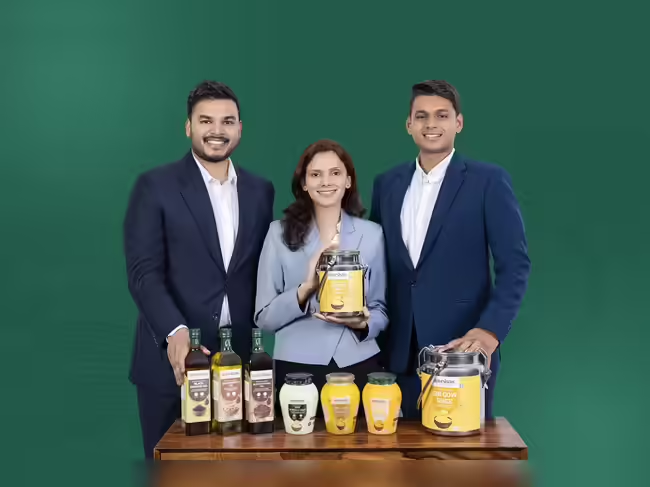
Indian clean-label food brand Anveshan has raised ₹150 crore ($15.7 million) in a Series B funding round led by Vertex Ventures Southeast Asia & India, with participation from the International Finance Corporation (IFC)—a member of the World Bank Group—Swiggy co-founder Sriharsha Majety, and existing investors including Wipro Consumer Care Ventures, Titan Capital, Force Ventures, and boAt founders Aman Gupta and Sameer Mehta.
The funding values the Gurugram-based startup at approximately ₹900–1,000 crore, more than doubling its April 2025 valuation of around ₹430 crore.
📊 From ₹74 Crore to ₹1,000 Crore: The Growth Trajectory
Anveshan, founded in 2020 by IIT Guwahati alumni Kuldeep Parewa, Akhil Kansal, and Aayushi Khandelwal, has demonstrated exceptional growth by leveraging India’s quick commerce boom to build a national clean-label brand.
| Metric | Value |
|---|---|
| FY25 Revenue | ₹74 crore |
| FY26 Expected Revenue | ₹192–220 crore |
| Current Annual Run Rate (ARR) | ₹280–300 crore |
| Target Revenue (FY27) | ₹350–500 crore |
| Long-Term Revenue Goal | ₹1,000 crore (24–30 months) |
🛍️ The Quick Commerce Flywheel
What sets Anveshan apart from traditional D2C brands is its strategic distribution mix. The startup has successfully ridden the quick commerce wave, with 30-40% of sales now coming from platforms like Blinkit and Zepto—a channel that barely existed when the company was founded.
| Channel | Revenue Contribution |
|---|---|
| Quick Commerce | ~35% |
| D2C (Website & App) | 25-30% |
| E-commerce Marketplaces | 25-30% |
| Offline Retail | <5% |
*”Almost 50-55% of our revenue is coming from tier 2, tier 3 cities. We realise that consumers beyond the top cities are aware of what they should put in their body and want to buy clean products.”*
— Kuldeep Parewa, Co-founder & CEO, Anveshan
🌾 Core Products and Expansion Plans
Anveshan sells minimally processed food products prepared traditionally, including A2 ghee, cold-pressed oils, raw honey, and Indian superfoods. The company currently operates with 16 manufacturing units across nine states and plans to consolidate these into five larger facilities to improve quality consistency and operational efficiency.
Product Portfolio:
- Core Categories (90% of revenue): Ghee and cooking oils (contribute almost equally)
- Newer Categories: Atta (flour), health mixes, and ready-to-eat products
“One thing that has set us apart is our ability to deliver consistent quality at scale. We are investing in manufacturing, testing and supply-chain capabilities that will support the next phase of growth.”
— Aayushi Khandelwal, Co-founder, Anveshan
💰 Investor Perspective: The Premiumisation Thesis
Kanika Mayar, Partner at Vertex Ventures Southeast Asia & India, articulated the investment thesis:
“India’s food and nutrition market is premiumising, with consumers seeking greater transparency, quality, and trust in the products they consume.”
The participation of IFC, the World Bank’s investment arm, adds institutional heft to the round. IFC typically backs companies with scalable business models and measurable social or environmental impact—in Anveshan’s case, its sourcing model works with food micro-entrepreneurs in rural areas.
🔮 What’s Next for Anveshan
The Series B capital will be deployed across four strategic priorities:
- Manufacturing Consolidation: Move from 16 units to 5 larger, standardised facilities
- Quality Infrastructure: Invest in testing and quality assurance capabilities
- Distribution Expansion: Increase offline presence through modern trade and general trade pilots
- Product Innovation: Expand portfolio while keeping ghee and oils as core revenue drivers (70-80% over next two years)
The startup now plans to increase its offline presence through modern trade, general trade pilots, and experiential formats such as pop-ups and sampling initiatives.
🏆 Competitive Positioning
Anveshan competes with brands including Two Brothers Organic Farms, Tata Sampann, and Organic Mandya. However, its aggressive use of quick commerce as a primary distribution channel gives it a distinctive advantage in urban markets, where speed and convenience are increasingly driving purchase decisions.
The company’s ₹1,000 crore revenue target over the next 24-30 months would make it one of India’s largest clean-label food brands—a milestone that would validate the thesis that Indian consumers are willing to pay a premium for transparency, quality, and traditional production methods.