Chennai’s Aheesa Digital Secures ₹20 Cr to Commercialize India’s First Indigenous RISC-V Networking Chip
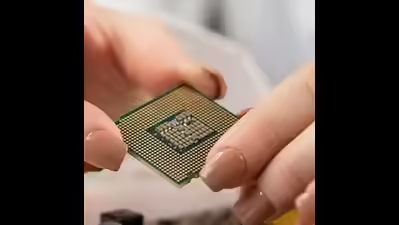
In every Indian home or office that enjoys high-speed fiber broadband, there is a small, unassuming white box. It terminates the optical cable and converts light into data, enabling our video calls, streaming, and work. Inside that box, historically, sits an imported chip—a piece of silicon designed and manufactured far from Indian shores.
A Chennai-based deep-tech startup is on a mission to change that.
Aheesa Digital Innovations Pvt. Ltd. , a fabless semiconductor company, has secured a ₹20 crore investment from the Tamil Nadu Infrastructure Fund Management Corporation (TNIFMC) to commercialize its indigenously designed networking chip, VIHAAN-I . Built on the open-standard RISC-V architecture, this chip represents a significant stride toward reducing India’s reliance on imported telecom hardware, a sector long dominated by global giants .
The Funding: A Strategic Bet on Deep-Tech
The investment is being channeled through the Tamil Nadu Emerging Sector Seed Fund (TNESSF), a SEBI-registered Category I AIF managed by TNIFMC . This fund is specifically designed to provide “risk capital” to companies in emerging sectors, fostering innovation, manufacturing, and R&D within the state .
K. Krishna Chaitanya, CEO of TNIFMC, emphasized the strategic nature of this bet. “By backing Aheesa’s indigenous SoC, we are supporting the development of key semiconductor capabilities while strengthening Tamil Nadu’s position as a hub for advanced electronics and deep-tech startups,” he stated .
This investment is perfectly aligned with the Tamil Nadu Semiconductor Mission 2030 and its broader vision of “Making in Tamil Nadu for the world” . The state government is actively positioning itself as a critical player in India’s quest for technological self-reliance.
The Visionaries: A Team Built for the Mission
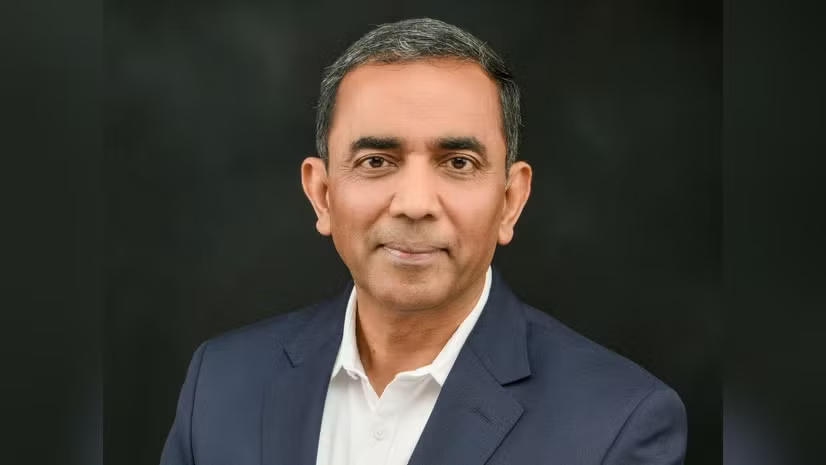
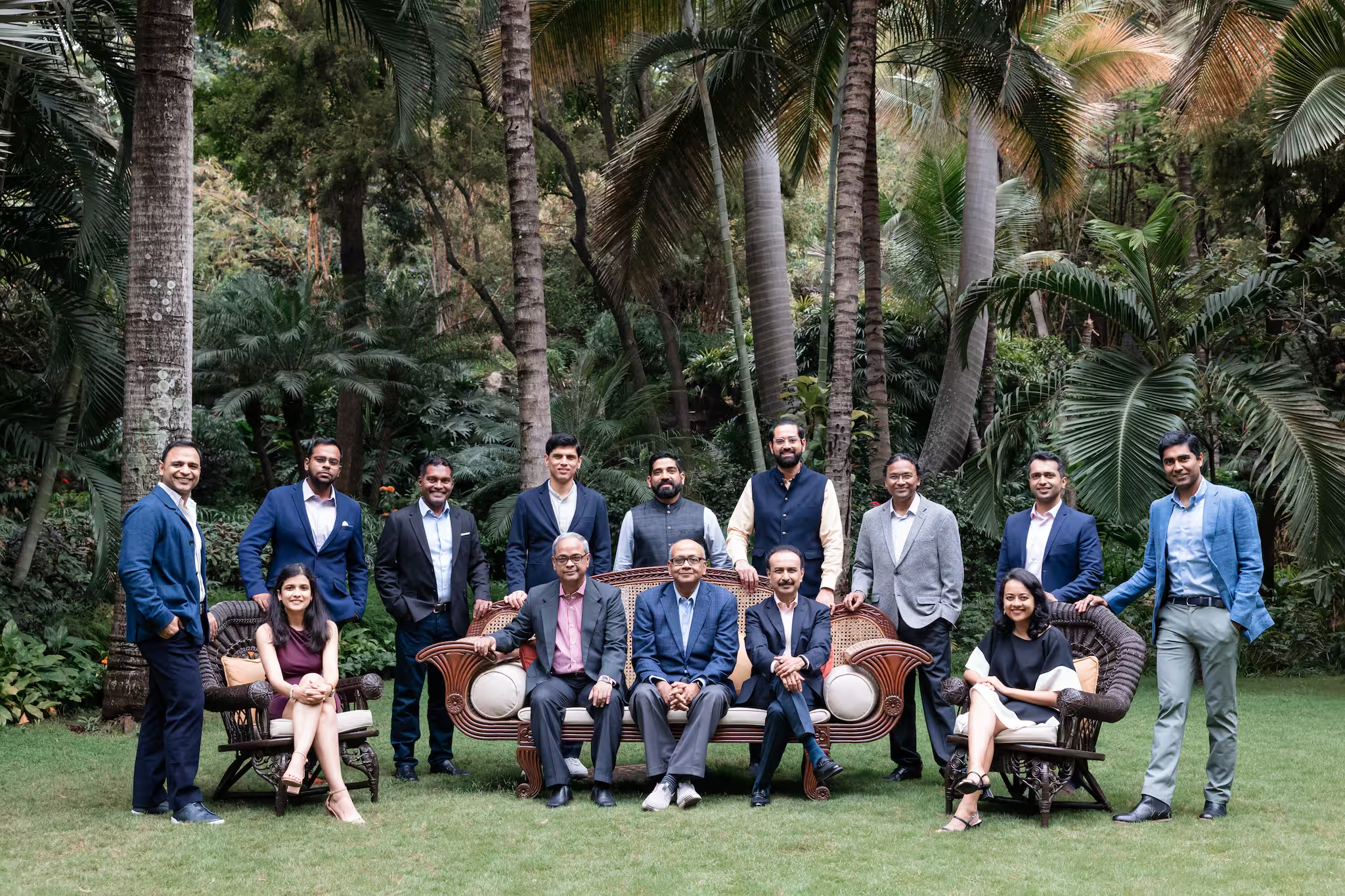
Aheesa was founded in 2021 by a team of industry veterans who bring a combined experience of over 25 years each in semiconductors, firmware, and global technology companies . The founding trio consists of:
Their backgrounds span prestigious organizations like Amazon, Microchip Technology, and American Megatrends . This is not a team of first-time entrepreneurs; it’s a team of seasoned experts who understand the intricacies of the semiconductor industry and the specific needs of the telecom sector. They are supported by government institutions, including the Ministry of Electronics and Information Technology (MeitY) and the India Semiconductor Mission (ISM) .
The Technology: VIHAAN-I and the Seshnag Platform
Aheesa’s flagship product is the VIHAAN-I, a 28-nanometer (nm) System-on-Chip (SoC) designed for optical fiber access networks .
1. Built on Open Standards
The chip is built around the Vega RISC-V processor core, developed by India’s Centre for Development of Advanced Computing (C-DAC) . The choice of an open-standard architecture like RISC-V is a deliberate one, driven primarily by security considerations. As CEO Sridharan Mani explained to EE Times, “Network is all about security. You need to know every component that goes into it. If the core is coming from India, you know the security is already in place” .
2. Targeting the Broadband Backbone
VIHAAN-I is engineered for Gigabit Passive Optical Network (GPON) and Ethernet PON (EPON) applications . These are the technologies used by telecom operators like Jio and Airtel to deliver high-speed fiber broadband to homes and offices (FTTH/FTTO). The chip interfaces with the Optical Line Terminals (OLTs) at the operator’s end and powers the Optical Network Terminals (ONTs)—the “white box” inside a user’s premises .
3. A Comprehensive Platform
VIHAAN-I is not just a standalone chip; it is the cornerstone of Aheesa’s Seshnag platform . This platform includes a reference hardware design, enabling Original Equipment Manufacturers (OEMs) and ODMs to quickly build and deploy networking products using the Indian chip. The business model is flexible, allowing customers to license the chip, adopt the reference platform, or procure finished, white-labeled end products .
The Strategic Importance: Why This Matters for India
The investment in Aheesa and the development of VIHAAN-I is a landmark event for several reasons.
1. Ending the Import Dependency
TNIFMC notes a critical vulnerability in India’s digital infrastructure: every Optical Network Terminal (ONT) device currently deployed in the country runs on imported silicon . This represents not just a strategic dependency but also a significant outflow of capital—”billions of rupees flowing overseas annually for chips that could be designed and produced domestically” . Aheesa’s chip is a direct answer to this problem.
2. Alignment with the India Semiconductor Mission
This milestone aligns perfectly with the government’s India Semiconductor Mission, which aims to build a self-reliant ecosystem in critical hardware technologies. Aheesa’s project is already backed by MeitY’s Design Linked Incentive (DLI) Scheme, providing crucial support for its design and development . The journey from DLI approval to tape-out and now to commercialization with state government support is a textbook example of how policy is translating into tangible product development.
3. A Model for Public-Private Partnership
The investment showcases a powerful model of collaboration. A central government scheme (DLI) provided the initial R&D support. A state-level fund (TNESSF) is now providing the crucial growth capital to take the product from tape-out to market. This handshake between the center and the state is vital for nurturing capital-intensive, long-gestation deep-tech ventures.
4. Forging a Path for “Fabless” India
Aheesa is a fabless semiconductor company, meaning it designs the chips but outsources the manufacturing. It has partnered with the global foundry UMC to manufacture VIHAAN-I . This model allows Indian startups to focus on their core strength—design and innovation—while plugging into the global semiconductor supply chain.
The Road Ahead: From Tape-Out to Market
Aheesa has already achieved the critical milestone of tape-out, meaning the chip design has been finalized and sent for manufacturing . The company expects to receive the first samples from the foundry by the end of the second quarter of 2026 .
The fresh ₹20 crore infusion from TNIFMC will be crucial for the next phase:
- Commercialization: Conducting further tests, trials, and engaging with prospective customers.
- Production: Ramping up to commence full-scale production, targeted for the first quarter of 2027 .
- Market Expansion: Targeting OEMs, ODMs, and system integrators who supply network equipment to telecom operators.
CEO Sridharan Mani has a clear vision that extends beyond India’s borders. “When you build technology for your own country, it is more special, but the idea is not only India. The idea is to go global,” he told EE Times .
The Final Word
Aheesa Digital Innovations’ ₹20 crore funding round is far more than just another startup investment. It is a testament to the maturity of India’s deep-tech ecosystem, proving that homegrown companies can design and build world-class semiconductor products that address critical national needs.
By developing the VIHAAN-I chip, Aheesa is not just building a product; it is building a foundation for India’s digital sovereignty. It is a powerful example of how patient capital, strong policy support, and world-class technical talent can converge to create a truly impactful venture, positioning India as a competitive player in the global semiconductor and telecom supply chain.