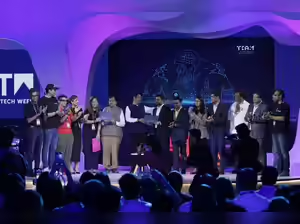
Humanoids, Drones, and Defence Tech: IIT-BHU’s Technex 2026 Showcases India’s Deep-Tech Future

For 87 years, the Indian Institute of Technology (BHU) has hosted Technex, Asia’s oldest techno-management festival . But what began as a student gathering has evolved into a powerful platform where academia, industry, and startups converge to shape the future of technology.
This year’s edition, held from March 13 to 15, 2026, was perhaps the most ambitious yet. With the theme ‘Fragments of Infinity‘ —symbolizing the limitless potential of human innovation and the intricate contributions of individual ideas that collectively drive large-scale technological progress —Technex 2026 offered a breathtaking window into India’s deep-tech ambitions .
From a humanoid robot that danced for the audience to a defense symposium featuring advanced military technology, and from conversations with the CEO of Ferrari to showcases of cutting-edge neuro-tech, the event underscored a simple truth: India’s startup ecosystem is no longer just about consumer apps—it is about building the technologies that will define the 21st century.
The Humanoid That Stole the Show
The highlight of the inaugural day was undoubtedly the Unitree G1 Humanoid Robot . Developed by Unitree Robotics, the G1 captivated attendees with its ability to walk, dance, and perform complex movements with startling precision . As part of the “Kaleidoscope” session, the robot’s performance served as a vivid testament to the rapid advancements taking place in the field of robotics .
For the students and entrepreneurs gathered at Swatantrata Bhawan, the message was clear: the future of robotics is here, and India must be part of it. The G1’s presence at Technex was not just a demonstration—it was an invitation to imagine what Indian startups could build in the years to come.
Defence Symposium 2.0: When the Indian Army Meets Innovation
One of the most significant aspects of Technex 2026 was the Defence Symposium 2.0, organized in collaboration with the 39 GTC, Garhwal Rifles, and the 50 Para Brigade of the Indian Army .
The exhibition showcased a range of state-of-the-art military technologies :
- Nano-drones and Remotely Piloted Aircraft Systems (RPAS) for surveillance and reconnaissance
- Advanced weapon systems and modern armaments
- All-terrain vehicles and armored light specialist vehicles
- “Robo-Mules” —autonomous ground vehicles designed to carry supplies in challenging terrain
- Night-vision equipment for enhanced operational capability
A particularly moving moment was the tribute paid to the courage and sacrifice of the nation’s soldiers through an emotional audio-visual presentation based on “Operation Sindoor” .
The defense symposium highlighted a growing trend: the increasing collaboration between the Indian armed forces and the country’s technology ecosystem. As India looks to strengthen its national security capabilities, startups in defence tech, drones, and autonomous systems have a critical role to play.
Beyond the Headlines: The Deep-Tech Ecosystem on Display
While the humanoid robot and defense exhibition captured the spotlight, Technex 2026 was also a showcase for the broader deep-tech ecosystem taking root across India.
The Rise of Tier 2/3 Innovation
Importantly, much of this innovation is not confined to metropolitan hubs. As Ramakrishna Commuri, CEO of Bhairav Robotics, noted in a recent analysis, cities that were once considered peripheral to high-technology industries are quietly becoming centers of defence and robotics innovation . Startups are emerging from Tier-II and Tier-III cities, powered by local engineering talent, lower operational costs, and targeted government programs .
Government Support and Policy Momentum
The government has recognized the strategic importance of deep-tech. Initiatives like the Draft National Deep Tech Startup Policy, the Research, Development and Innovation (RDI) Scheme, and the iDEX scheme for the defence sector are creating a supportive environment for startups working on cutting-edge technologies .
The numbers tell the story: 47 homegrown deep-technology companies raised $997 million in January and February 2026 alone , up from $162 million in the same period last year. Deep-tech startups raised $1.65 billion in all of 2025 .
Investment in Defence Robotics
The potential of the sector is also attracting major corporate investment. Solar Defence and Aerospace Limited (SDAL) recently announced a massive ₹12,800 crore investment in robotics, drone manufacturing, and advanced deep-tech projects . The initiative, to be located in Nagpur’s MIHAN Special Economic Zone, aims to produce around 10,000 drones and 1,000 robots annually , creating approximately 6,800 jobs .
The Ferrari Connection: Lessons in Precision Engineering
The inaugural “Think Talk” session featured Benedetto Vigna, CEO of Ferrari , moderated by Sergius Barretto, Managing Editor of Autocar India . Vigna shared his insights on precision engineering, luxury automobile technology, and the global innovations reshaping the automotive industry . He also shed light on Ferrari’s strategic vision for the upcoming Formula One season and emphasized the critical importance of teamwork .
For the young technocrats in the audience, the message was inspiring: whether you’re building a supercar or a startup, excellence comes from attention to detail, relentless innovation, and a commitment to pushing boundaries.
Academia-Industry Collaboration: The Technex Model
Technex 2026 demonstrated the power of bringing together different stakeholders in the innovation ecosystem.
- Academia: IIT-BHU provided the platform, the talent, and the intellectual energy.
- Industry: From Ferrari to Jane Street to Tredence (which conducted hackathons ), industry partners brought real-world problem statements and expertise.
- Government: The involvement of the Indian Army highlighted the growing role of public institutions in supporting technology development.
- Startups: Emerging ventures had the opportunity to showcase their work, connect with mentors, and attract investment.
This model of collaboration is essential if India is to realize its deep-tech ambitions. As the Bharat Innovates 2026 initiative—which will take over 100 deep-tech startups to France in June—demonstrates, there is a concerted push to bridge the gap between laboratory research and commercial success .
The Road Ahead: India as a Deep-Tech Powerhouse
Events like Technex 2026 are important not just for what they showcase, but for what they symbolize. They represent a shift in mindset—a recognition that Indian entrepreneurs can build world-class technologies in fields like robotics, defence, aerospace, and neuro-tech.
The challenges remain significant. Converting patents into commercial products, attracting patient capital, and building global-scale companies are all hard problems . But the momentum is undeniable.
As India granted over 100,000 patents last year —a dramatic surge compared to pre-pandemic data —the foundation for innovation-led growth is being laid. The startups that emerged from Technex 2026 may well be the ones that, a decade from now, are recognized as global leaders in their fields.
The Final Word
Technex 2026 at IIT-BHU was more than just a college festival. It was a powerful demonstration of India’s deep-tech potential—a glimpse into a future where Indian startups build humanoid robots, advanced defence systems, and neuro-tech devices that compete with the best in the world.
The “Fragments of Infinity” theme was apt. Each innovation on display was a fragment—a piece of a larger puzzle. But together, they point toward a future that is limitless in its possibilities.
For the students, entrepreneurs, and innovators who attended, the message was clear: the future is being built now. And India is building it.