

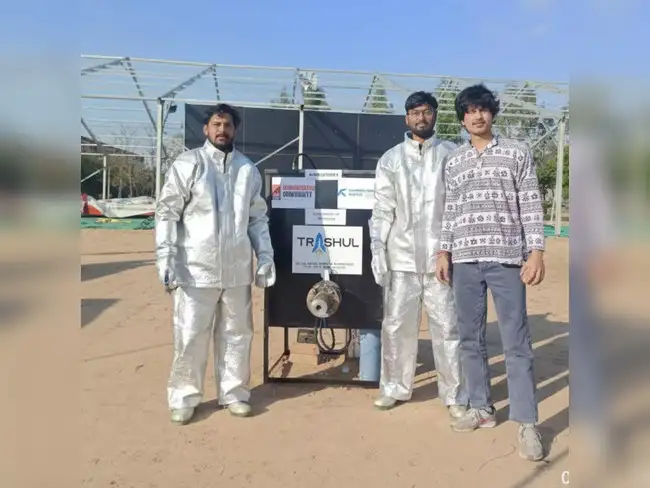
In a significant boost for India’s deep-tech spacetech ambitions, Prayagraj-based startup Trishul Space has successfully secured ₹4 crore (approximately $480,000) in a pre-seed funding round. The investment was led by the IAN Angel Fund, with key participation from 8X Ventures and ITEL, marking a strong vote of confidence in a startup tackling one of the most complex and critical challenges in modern spaceflight: next-generation, reusable rocket propulsion.
The Trishul Vision: Building the Heart of the Rocket
Founded in 2022 by IIT alumni Aditya Singh, Divyam, and Rajat Choudhary, Trishul Space is not building satellites or launch vehicles. Instead, it is focusing on the very core of rocketry: the engine. The company specializes in developing advanced liquid rocket propulsion systems.
Their approach is not incremental; it’s transformative. They are leveraging staged combustion cycles, one of the most efficient but complex rocket engine cycles, which is crucial for achieving the high performance needed for reusable launch vehicles. Furthermore, they are integrating AI-driven failure detection systems from the ground up, aiming to drastically enhance reliability, slash development costs, and shorten the notoriously long timelines associated with engine development.
The Harpy-1 Engine: A Flagship for the Small Satellite Revolution
The immediate goal for this pre-seed funding is to fast-track the development of their flagship product: the Harpy-1. This high-performance liquid engine is specifically designed for the burgeoning market of small satellite launch vehicles.
The small satellite market is exploding, and with it, the demand for dedicated, cost-effective, and frequent launches. Trishul Space is positioning itself as the propulsion provider for this new wave of launch providers, both private and governmental. By offering a reliable, advanced engine, they enable launch vehicle companies to focus on their core vehicle integration and mission management, rather than the immense R&D challenge of building an engine from scratch.
The Market Opportunity: Tackling the Cost Bottleneck
The business case for Trishul is compelling. Propulsion systems account for a staggering 30-40% of a launch vehicle’s total cost. In a global small and medium launch vehicle market projected to reach $15 billion by 2030, the value of a reliable, cost-effective, and domestically produced propulsion system is immense.
For India, this is a strategic imperative. As the country’s private space sector, already valued at over $13 billion, continues to mature, achieving self-reliance in critical subsystems like rocket engines is a cornerstone of the Atmanirbhar Bharat (Self-Reliant India) vision. Trishul Space is not just building a business; it is building national capability.
The Fuel for Growth: How the ₹4 Crore Will Be Deployed
This pre-seed capital is earmarked for critical, early-stage milestones that are essential for de-risking the technology and attracting future, larger rounds of investment. The funds will be primarily deployed to:
- Accelerate R&D: Intensifying research into their core technologies, particularly the complex turbopump—the heart of a liquid rocket engine that feeds propellants into the combustion chamber at extremely high pressures.
- Conduct Crucial Testing: Moving from theoretical designs and simulations to building and testing sub-scale components and prototypes. This phase is vital for validating their engineering and making necessary iterations.
- Advance the Harpy-1 Prototype: Fast-tracking the development path of the Harpy-1 engine toward a commercial-ready product.
The Ecosystem Play: Mentorship and Strategic Positioning
Beyond the capital, gaining the backing of the IAN Angel Fund brings a significant advantage: mentorship. The Indian Angel Network comprises seasoned entrepreneurs and industry experts who can provide invaluable guidance on technology, business strategy, and navigating the complex aerospace regulatory landscape.
Operating from IIT Delhi’s Research & Innovation Park also provides Trishul with access to academic expertise, lab facilities, and a collaborative deep-tech environment. They are now firmly positioned alongside peers like Skyroot Aerospace and Agnikul Cosmos, creating a synergistic ecosystem where multiple Indian companies are solving different parts of the space puzzle.
Conclusion: The Thrust is Building
The successful pre-seed round for Trishul Space is a powerful signal. It demonstrates that Indian investors are willing to back highly ambitious, technically complex, and long-gestation deep-tech ventures. For founders Aditya, Divyam, and Rajat, this is a validation of their bold vision to make space access faster and more affordable by mastering its most fundamental technology.
To follow Trishul Space’s journey and stay updated on the latest in Indian spacetech, explore in-depth profiles and funding trackers at StartupPoint.in.