

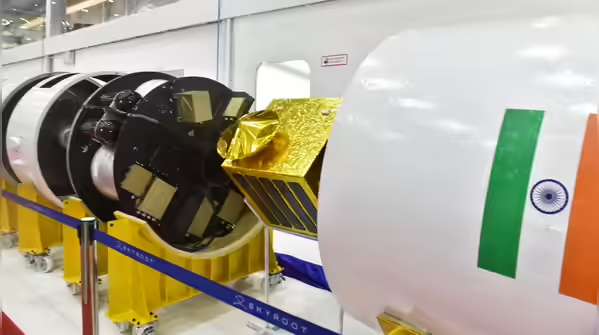
The final frontier is about to get a new gateway, and it’s being built not just by a nation, but by a new generation of pioneers. Hyderabad-based Skyroot Aerospace, a spacetech unicorn, is in the final stages of preparation for the maiden launch of Vikram-I—a mission that will mark a monumental first: India’s first privately developed commercial orbital rocket.
Scheduled for a liftoff later this year from the hallowed grounds of the Satish Dhawan Space Centre in Sriharikota, this event is more than a test flight; it is the culmination of a bold vision to democratize space access and firmly plant India’s flag in the global commercial space race.
The Genesis: From ISRO Labs to Startup Dreams
Founded in 2018 by former ISRO scientists Pawan Kumar Chandana (CEO) and Naga Bharath Daka, Skyroot was born from a deep understanding of space technology and a burning ambition to build upon India’s legacy in space exploration. Their mission was clear: to create cost-effective, reliable, and frequent launch services for the burgeoning small satellite market.
The name “Vikram” is a heartfelt tribute to Dr. Vikram Sarabhai, the father of the Indian space program, symbolizing a direct lineage of ambition and innovation from the national program to the private sector.
Vikram-I: A Technical Powerhouse
- Class: A three-stage, all-composite rocket.
- Payload Capacity: Can deploy up to 480 kg to a 500 km Low Earth Orbit (LEO) or 290 kg to a Sun-Synchronous Orbit (SSO).
- Key Innovation: The restartable Orbital Adjustment Module (OAM). This critical technology allows the rocket to precisely deploy multiple satellites into different orbits on a single mission, a highly sought-after capability for launch operators and their clients.
Clearing the Path: The Critical Milestones to Launch
The journey to the launchpad has been paved with a series of successful, high-stakes tests that have de-risked the mission and built immense confidence:
- August 2025 Static Fire Test: In a landmark achievement, Skyroot successfully conducted a full-duration static fire test of its Kalam-1200 first-stage booster. This massive solid motor burned for 110 seconds, consuming 30 tonnes of propellant, and stands as the largest private solid rocket motor ever built in India.
- Suborbital Precedent: The current momentum builds on the success of the Vikram-S mission in 2022, which was India’s first privately developed rocket to reach space, successfully demonstrating key technologies in a suborbital flight.
- Comprehensive System Tests: The company has also successfully tested other critical systems, including payload fairing separation, stage separation mechanisms, and its cryogenic engines (Kalam-250 and Kalam-100).
The Business of Launch: A Market Ready for Takeoff
Vikram-I’s maiden flight is already a commercial venture. It is slated to carry a mix of Indian and international CubeSats, with clients including the Swedish Space Corporation (SSC). This demonstrates global demand for affordable and flexible launch options for small satellites, which are used for everything from earth observation and communications to scientific research.
This mission is a powerful validation of the business model underpinning Skyroot and India’s private space sector as a whole.
The Fuel Behind the Rocket: Financial and Policy Support
Skyroot’s audacious vision has been backed by formidable financial firepower. The company has raised over ₹1,150 crore (approx. $140 million) from a consortium of top-tier investors, including Singapore’s GIC, Temasek, and Mukesh Ambani’s Reliance Industries.
This massive investment is a testament to the belief in the commercial viability of private spaceflight in India. Furthermore, this growth has been enabled by a supportive policy framework, including:
- IN-SPACe: The Indian National Space Promotion and Authorisation Centre, which acts as a single-window, autonomous agency for enabling private sector participation in space activities.
- Atmanirbhar Bharat: The national vision for self-reliance, of which achieving sovereign capability in space transportation is a cornerstone.
The Ripple Effect: Pioneering a New Ecosystem
The success of Vikram-I will have effects far beyond Skyroot itself. It will:
- Validate the Ecosystem: Prove that private Indian companies can design, build, and launch orbital-class rockets.
- Spur Competition: Encourage and validate the efforts of rivals like Agnikul Cosmos, which is developing its own small satellite launch vehicle, creating a healthy and competitive market.
- Drive Sector Growth: Catalyze the entire $13+ billion Indian private space market, which is projected to grow 10x by 2030, by providing the crucial “last mile” service of getting payloads into orbit.
Conclusion: More Than a Rocket, A Symbol of a New India
As CEO Pawan Kumar Chandana powerfully declared, “Vikram-I isn’t just a rocket; it’s India’s ticket to on-demand space access!”
This statement captures the profound shift this launch represents. It signifies a transition from a period where space access was a complex, state-controlled endeavor to an era where it becomes a reliable, on-demand utility for businesses, researchers, and innovators.