
Funding News

Velmenni Raises ₹30 Cr to Bring Li-Fi to India: Lighting the Path to 6G and Secure Connectivity

For decades, the invisible airwaves around us—radio frequencies—have been the workhorses of wireless communication. Wi-Fi, 4G, 5G, Bluetooth: all rely on a spectrum that is increasingly congested, interference-prone, and vulnerable to interception.

But what if the very lights in our offices, homes, and streets could also carry the internet? What if a beam of light, invisible to the naked eye, could deliver speeds of 10 Gbps with absolute security?

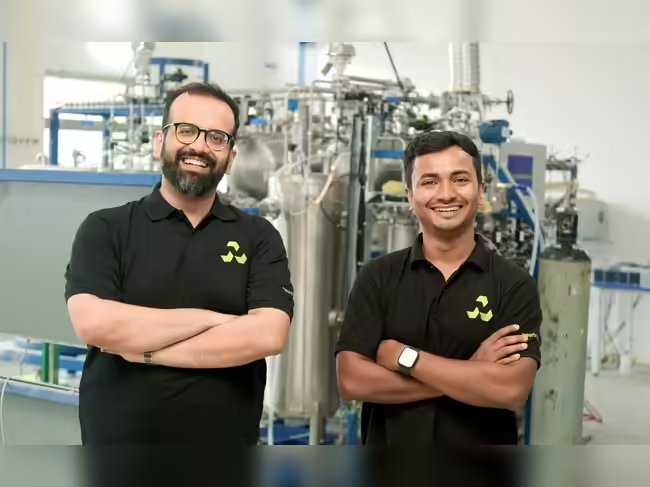
This is not science fiction. This is the reality being built by Velmenni, a Delhi-based deep-tech startup that has just raised ₹30 crore (approximately $3.3 million) in a pre-Series A funding round to scale its pioneering Li-Fi (Light Fidelity) and Free Space Optics (FSO) technologies .

Read More

Startup Mafia 2.0: How Zomato, Zoho, and Freshworks Alumni Are Building India’s Next 360 Ventures

In Silicon Valley, the PayPal Mafia became legendary—a group of former employees and founders who went on to build YouTube, Tesla, LinkedIn, and Yelp, forever changing the technology landscape. India is now witnessing its own version of this story, not once, but in successive waves.

The latest data is staggering. According to an analysis by Longhouse for the Economic Times, the second generation of India’s startup mafia—alumni from companies built between roughly 2014 and 2025—have now launched around 360 startups cumulatively . This marks a sharp increase from 253 companies reported in 2023, demonstrating the accelerating pace of this entrepreneurial spillover .

Read More

From Rockets to Retirees: EDII’s Empresario 2026 Showcases the Astonishing Diversity of India’s Startup Ecosystem

From March 12 to 14, the EDII campus transformed into a cauldron of innovation, bringing together over 1,000 students, founders, industry mentors, and investors . But what made this gathering truly special was not just the numbers—it was the breathtaking diversity of ideas on display.

Startups ranging from rocket manufacturers to platforms for retired professionals rubbed shoulders at the exhibition. IoT-based drones for precision farming stood alongside health-tech devices designed to improve accessibility and patient outcomes. Aerospace ventures shared space with agritech innovators and makers of natural sweeteners for diabetics

Read More

 Humanoids, Drones, and Defence Tech: IIT-BHU’s Technex 2026 Showcases India’s Deep-Tech Future

This year’s edition, held from March 13 to 15, 2026, was perhaps the most ambitious yet. With the theme ‘Fragments of Infinity’ —symbolizing the limitless potential of human innovation and the intricate contributions of individual ideas that collectively drive large-scale technological progress —Technex 2026 offered a breathtaking window into India’s deep-tech ambitions .

From a humanoid robot that danced for the audience to a defense symposium featuring advanced military technology, and from conversations with the CEO of Ferrari to showcases of cutting-edge neuro-tech, the event underscored a simple truth: India’s startup ecosystem is no longer just about consumer apps—it is about building the technologies that will define the 21st century.

Read More

Newtrace Raises $6.3M from HDFC Bank and Mitsui to Scale Green Hydrogen Electrode Technology

Green hydrogen has long been hailed as the clean fuel of the future—a way to decarbonize hard-to-abate sectors like steel, refining, fertilizers, and heavy transport. By using renewable energy to split water into hydrogen and oxygen, it offers a path to zero-emission industrial processes.

But there has always been a catch: cost.

Green hydrogen currently costs between $4 and $10 per kilogram, compared to around $2 for conventional “grey” hydrogen produced from fossil fuels . A large share of this cost comes from losses in the electrolyser stack, especially the electrode .

Read More

India’s $11 Billion Semiconductor Fund: A Game-Changer for Deep-Tech Startups and Global Ambitions

In the modern world, semiconductors are the new oil. They power everything from smartphones and cars to satellites and AI data centers. Without chips, the digital economy grinds to a halt.

For decades, India has been a consumer of semiconductors, importing nearly all of its requirements. Despite having world-class chip design talent, the country has lacked the manufacturing infrastructure to turn designs into physical products.

That is about to change in a big way.

India is preparing a massive $11 billion semiconductor fund to strengthen its chip manufacturing ecosystem, marking one of the country’s most ambitious deep-tech initiatives to date . The move is designed to reduce dependency on imports and position India as a global electronics hub, aligning with the government’s vision of technological self-reliance.

Read More

Basil Health Raises $1.5M to Build AI-Powered Smart Vending Networks for Healthier Beverages

In the chaos of a bustling Indian city, grabbing a healthy drink is not always easy. Your options are often limited to sugary sodas from corner stores, overpriced smoothies from cafes, or packaged juices with questionable nutritional value.

But what if you could walk up to a sleek, automated kiosk, tap a screen, and within seconds receive a freshly dispensed, healthy beverage tailored to your preferences—available 24/7, with no human interaction required?

This is the vision of Basil Health, a Delhi-based startup that is building the infrastructure for exactly this future.

Read More

Invention Engine Portfolio Startups Raise $2.5M: How Accelerators Are Fueling India’s Early-Stage Innovation

In the world of startups, timing is everything. An idea can be brilliant, a team can be talented, and a market can be massive—but without the right support at the right moment, even the most promising ventures can falter.

This is where accelerators come in. They provide the critical bridge between an idea and a business, offering not just capital but also mentorship, strategic guidance, and access to networks that can make all the difference.

A recent funding round underscores the power of this model. Several startups from the Invention Engine accelerator portfolio have collectively raised approximately $2.5 million in fresh funding. Companies such as Sonic Lamb, Cheerio AI, and Desible.ai are among those benefiting from this investment, which will be directed toward scaling product development, enhancing technology platforms, and expanding market reach.

Read More

Weekly Funding Wrap: Indian Startups Raise $139M as Investor Caution Reshapes the Landscape

The Indian startup ecosystem has always been a story of cycles. Boom follows bust. Exuberance follows caution. And in between, the signal emerges from the noise.

The latest weekly funding data offers a fascinating snapshot of where the ecosystem stands in early 2026.

Between March 7 and March 13, Indian startups collectively raised approximately $139 million. On the surface, that’s a respectable number—millions of dollars deployed into innovative companies across sectors.

But context matters. Compared to the same period last year, funding activity has seen a sharp decline. And beneath the headline number lies a more nuanced story about the changing priorities of investors and the evolving expectations for founders.

Read More

Oolka Raises $12M Led by Accel to Automate Financial Operations for Indian Startups and SMEs

For years, the conversation around artificial intelligence in finance was dominated by chatbots and fraud detection. Useful, yes. Transformative? Not quite.

But a new wave of AI-powered fintech is emerging—one that goes far beyond incremental improvements. These platforms are reimagining the very foundations of how businesses manage their money.

Oolka is at the forefront of this revolution.

The AI-powered fintech startup is making headlines as it prepares to raise approximately $12 million in a funding round led by Accel, one of the world’s most prestigious venture capital firms. This marks a significant milestone not just for Oolka, but for India’s broader fintech ecosystem, where artificial intelligence is increasingly being integrated into the core of financial services.

Read More