
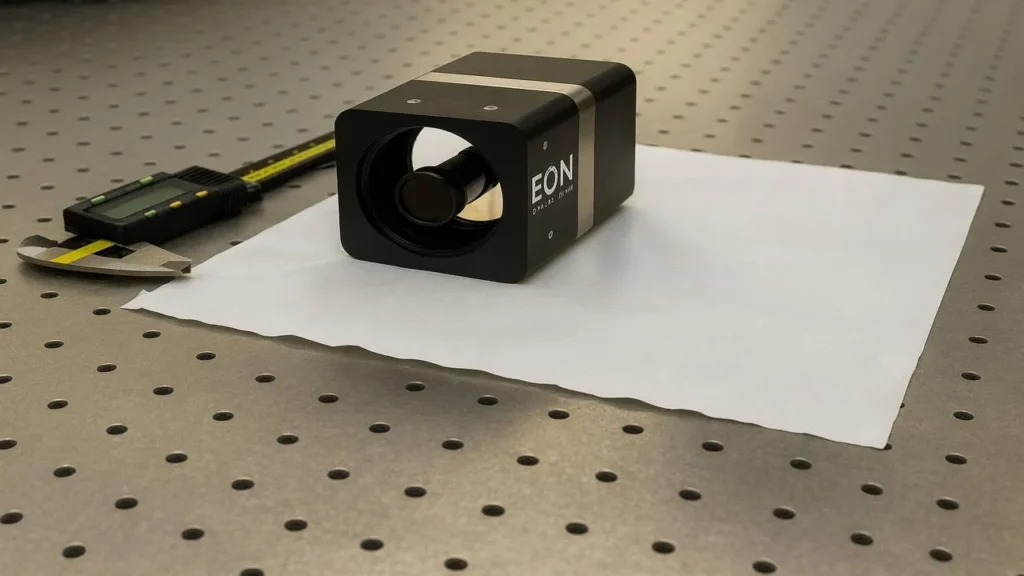
In a landmark achievement for India’s private space sector, Hyderabad-based deep-tech startup EON Space Labs has successfully cleared a critical milestone for its pioneering miniaturized space telescope, MIRA. The telescope has successfully undergone rigorous thermo-vacuum testing, proving its readiness for the harsh environment of space and marking a significant step in India’s quest for self-reliance in critical space technologies.
The Crucible of Space: Passing the Thermo-Vacuum Test
The recent tests are among the most critical any space-bound hardware must pass. Conducted at a National Accreditation Board for Testing and Calibration Laboratories (NABL)-accredited facility in Ahmedabad, the tests subjected the MIRA telescope to the extreme conditions of Low Earth Orbit (LEO):
- Extreme Vacuum: Simulating the near-perfect vacuum of space with pressure levels below 10⁻⁵ torr.
- Brutal Temperature Swings: Cycling temperatures from a frigid -20°C to a scorching +60°C, mimicking the transition from the shadow of the Earth to direct sunlight.
The results were exemplary. EON Space Labs reported zero optical drift, negligible outgassing (the release of gases from materials), and full operational reliability, meeting the stringent standards set by agencies like NASA. This means the telescope’s alignment remains perfect, its lenses don’t fog up from internal contaminants, and it functions flawlessly despite the brutal conditions—a testament to its robust design and manufacturing quality.
The MIRA Advantage: Lighter, Cheaper, and Uncompromising
The significance of MIRA’s lightweight design cannot be overstated. In the space industry, every gram counts, with launch costs often running up to $20,000 per kilogram. By being 3-4 times lighter than conventional space telescopes, MIRA delivers massive cost savings on payload without compromising on its core function: capturing high-resolution imagery.
This breakthrough opens up a world of possibilities:
- Strategic Defense: Enabling smaller, more agile satellites for reconnaissance and surveillance.
- Precision Earth Observation: Facilitating more frequent and cost-effective monitoring of agriculture, forestry, urban planning, and disaster management.
- Commercial Missions: Allowing smaller companies and research institutions to host powerful imaging capabilities on their satellites, a service previously out of reach for many.
As co-founder Punit Badeka noted, “MIRA enables highest-quality imagery at a fraction of traditional limitations.” This is the core of its disruptive potential.
The Founders and the Forthcoming Heritage Flight
Founded in 2022 by Sanjay Kumar, Punit Badeka, and Manoj Kumar Gaddam, EON Space Labs embodies the new wave of Indian deep-tech entrepreneurship—tackling complex, hardware-intensive challenges with global relevance.
The success in the lab now paves the way for the ultimate test: space. The company is gearing up for MIRA’s heritage flight aboard a satellite mission with TakeMe2Space in December 2025. A successful in-orbit demonstration will be the final validation, transforming MIRA from a promising prototype into a flight-proven product ready for the global market.
The Bigger Picture: Aligning with a National Vision
EON Space Labs’ achievement is a microcosm of the larger Atmanirbhar Bharat (Self-Reliant India) and IndiaAI Mission visions in action.
- Technological Sovereignty: Developing a critical subsystem like a space telescope indigenously reduces dependency on foreign imports and strengthens national security.
- Spurring the Ecosystem: Successes like this create a virtuous cycle, inspiring other startups, attracting investment, and building a robust supply chain for the private space industry.
- Global Competitiveness: MIRA positions India not just as a launch service provider, but as a developer and exporter of high-value space technology.
Conclusion: The Stars Are Aligning for Indian Spacetech
The successful testing of the MIRA telescope is more than a technical milestone; it is a powerful signal. It demonstrates that Indian startups possess the engineering rigor, innovation, and ambition to compete at the highest levels of the global space tech industry.